

Donchian Channel Breakout Algo: Fix False Breakout Risks + Full ALGOGENE Backtest Code for Daily Gold Trading
Trading Strategy
Strategy Background
The Donchian Breakout Strategy is a classic trend-following trading system developed by Richard Donchian, widely regarded as the “father of trend following”. First introduced in the 1960s, this strategy has stood the test of decades of market changes and remains a core tool for systematic algorithmic traders.
Unlike range-bound trading strategies that rely on buying low and selling high, the Donchian breakout strategy focuses on capturingsustained market trend momentum. Its core logic is simple and robust: financial markets tend to form continuous trending movements after breaking historical price ranges. The strategy identifies valid trend breakouts via the Donchian Channel and executes long/short trades to profit from subsequent price trends.
This strategy is highly adaptable to liquid trending markets, especially suitable for commodity and forex markets like Gold (XAUUSD). This guide will elaborate on the strategy’s core ideas, trading formulas, algorithmic logic, backtest results, inherent risks and optimization solutions, with a complete ALGOGENE API code example for daily XAUUSD trading.
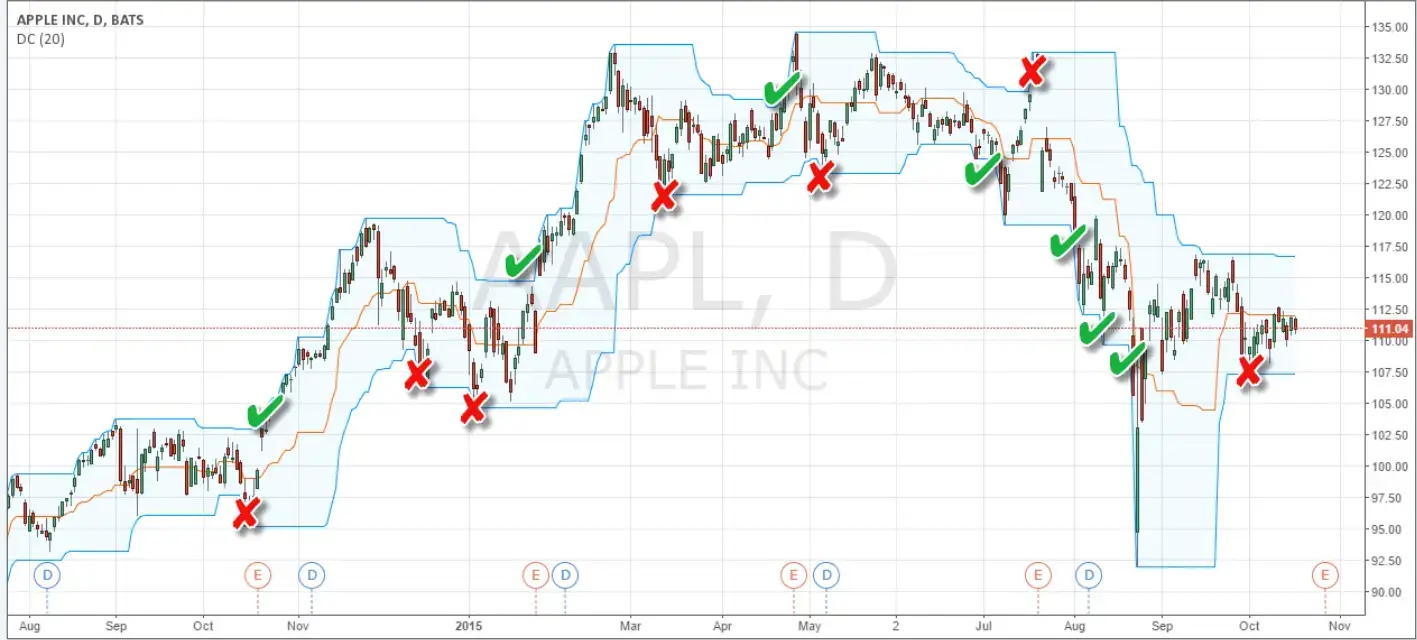
Core Strategy Idea & Trading Rules
Donchian Channel Core Definition
The Donchian Channel is a price channel formed by the highest high and lowest low of historical prices over a fixed lookback period. It effectively marks the recent trading range of an asset’s price, breaking through this range indicates
To avoid look-ahead bias in actual trading, the strategy excludes the latest unfinished price bar when calculating the channel, only using historical closed bars to determine the range boundary.
Standard Trading Signal Rules:
- Long Signal (Bullish Breakout): When the closing price of the latest daily bar breaks above the highest high of the previous N-period historical price range, go long the asset.
- Short Signal (Bearish Breakout): When the closing price of the latest daily bar breaks below the lowest low of the previous N-period historical price range, go short the asset.
- Position Holding Rule: All opened positions will be automatically closed after a fixed holding period to avoid excessive trend retracement risks and ensure regular capital turnover.
- Position Sizing Rule: Use a fixed percentage of available account balance for each position opening to control capital utilization and risk dispersion.
Strategy Mathematical Formula & Logic
1. Donchian Channel Boundary Calculation
Set the lookback period as N (default 20 periods in this strategy), extract the high and low prices of the previous N closed daily bars:
- ChannelHigh = Max(Hight-N, Hight-N+1, ..., Hight-1)
- ChannelLow = Min(Lowt-N, Lowt-N+1, ..., Lowt-1)
Where: t = current bar time, exclude the latest bar t to eliminate look-ahead bias.
2. Trading Signal Judgment Formula
Let Closet = closing price of the current daily bar:
- If Closet > ChannelHigh → Signal = 1 (Open Long Position)
- If Closet < ChannelLow → Signal = -1 (Open Short Position)
- If price stays within the channel range → Signal = 0 (No Trade)
3. Position Holding & Exit Logic
Set the maximum holding period as T (default 5 days in this strategy). After opening a position, count the daily holding days in real time. When the holding days reach T, force close the position regardless of profit or loss to lock trend profits and avoid reversal risks.
4. Position Sizing Calculation
The strategy uses 95% of the available account balance for position opening to maximize capital utilization while retaining a small amount of margin buffer:
- Investment Capital = Available Balance × 95%
- Trade Volume = (Investment Capital)/(Entry Price × Contract Size)
Full Backtest Script
The following complete Python script implements the Donchian Breakout Strategy for daily XAUUSD (Gold) trading. The code integrates signal calculation, position opening/closing logic, holding period management, duplicate order prevention and position status synchronization, supporting direct backtesting via ALGOGENE platform.
Backtest Config
- Trading Instrument: XAUUSD (Spot Gold)
- Data Interval: Daily (1D) price bars
- Initial Capital: $10,000 USD
- Leverage: 100x
- Donchian Lookback Period: 20 days
- Maximum Holding Period: 5 days
- Capital Utilization Rate: 95% of available balance per trade
1 2 3 4 5 6 7 8 9 10 11 12 13 14 15 16 17 18 19 20 21 22 23 24 25 26 27 28 29 30 31 32 33 34 35 36 37 38 39 40 41 42 43 44 45 46 47 48 49 50 51 52 53 54 55 56 57 58 59 60 61 62 63 64 65 66 67 68 69 70 71 72 73 74 75 76 77 78 79 80 81 82 83 84 85 86 87 88 89 90 91 92 93 94 95 96 97 98 99 100 101 102 103 104 105 106 107 108 109 110 111 112 113 114 115 116 117 118 119 120 121 122 123 124 125 126 127 128 129 130 131 132 133 134 135 136 137 138 139 140 141 142 143 144 145 146 147 148 149 150 151 152 153 154 155 156 157 158 159 160 161 162 163 164 165 166 167 168 169 170 171 172 173 174 175 176 177 178 179 180 181 182 183 184 185 186 187 188 189 190 191 192 193 194 195 196 197 198 199 200 201 202 203 204 205 206 207 208 209 210 211 212 213 214 215 216 217 218 219 220 221 222 223 224 225 226 227 228 229 230 231 232 233 234 235 236 237 238 239 240 241 242 243 244 245 246 247 248 249 250 251 252 253 254 255 256 257 258 259 260 261 262 263 264 265 266 267 268 269 270 271 272 273 274 275 276 277 278 279 280 281 282 283 284 285 286 287 288 289 290 291 292 293 294 295 296 297 298 299 300 301 302 303 304 305 306 307 308 309 310 311 312 313 314 315 316 317 318 319 320 321 322 323 324 325 326 327 328 329 330 331 332 333 334 335 336 337 338 339 340 341 342 343 344 345 346 347 348 349 350 351 352 353 354 355 356 357 358 359 360 361 362 363 364 365 366 367 368 369 370 371 372 373 374 375 376 377 378 379 380 381 382 383 384 385 386 387 388 389 390 391 392 393 394 395 396 397 398 399 400 401 402 403 404 405 406 407 408 409 410 411 412 413 414 415 416 417 418 419 420 421 422 423 424 425 426 427 428 429 430 431 432 433 434 435 436 437 438 439 440 441 442 | from AlgoAPI import AlgoAPIUtil, AlgoAPI_Backtest from datetime import datetime, timedelta import numpy as np class AlgoEvent: def __init__(self): # Target instrument self.instrument = "XAUUSD" # Strategy parameters self.holdMax = 1 self.periods = 5 # Holding period in daily bars self.donchian_lookback = 20 # Donchian channel lookback self.position_cash_pct = 0.95 # Use 95% of available balance when opening a position # Runtime variables self.last_bar_time = datetime(1970, 1, 1) self.hold_days = {} # tradeID -> holding days self.open_trade_ids = set() # Active trade IDs self.pending_open = False # Avoid duplicate open orders before order confirmation self.pending_close_ids = set() # Track submitted close orders # Contract specification self.contract_size = 1 # Debug controls self.debug = True self.debug_bar_count = 0 self.debug_log_every_n_bars = 10 def start(self, mEvt): self.evt = AlgoAPI_Backtest.AlgoEvtHandler(self, mEvt) self.evt.consoleLog("Subscribed instruments:", mEvt.get("subscribeList", [])) if self.instrument not in mEvt.get("subscribeList", []): self.evt.consoleLog( "WARNING:", self.instrument, "is not in subscribeList. Please add XAUUSD to the backtest instrument list." ) # Get contract size for position sizing try: spec = self.evt.getContractSpec(self.instrument) self.contract_size = spec.get("contractSize", 1) self.evt.consoleLog("Contract spec for", self.instrument, "=", spec) self.evt.consoleLog("Contract size for", self.instrument, "=", self.contract_size) except Exception as e: self.contract_size = 1 self.evt.consoleLog("Failed to get contract spec, using contract_size=1. Error:", str(e)) self.evt.start() def on_bulkdatafeed(self, isSync, bd, ab): """ Main Donchian breakout strategy logic. Evaluates once per daily bar. """ if self.instrument not in bd: if self.debug: self.evt.consoleLog( "Instrument not found in bulk data:", self.instrument, "available symbols:", list(bd.keys()) ) return bar = bd[self.instrument] current_time = bar["timestamp"] # Run once per daily bar if current_time < self.last_bar_time + timedelta(hours=24): return self.last_bar_time = current_time self.debug_bar_count += 1 if self.debug and self.debug_bar_count == 1: self.evt.consoleLog( "First valid bar received:", self.instrument, "time:", current_time, "open:", bar["openPrice"], "high:", bar["highPrice"], "low:", bar["lowPrice"], "close:", bar["lastPrice"], "bid:", bar["bidPrice"], "ask:", bar["askPrice"] ) # Step 1: update holding period and close expired positions self.update_holding_days_and_close_expired() # Step 2: avoid opening if already in position or waiting for open confirmation if self.has_position() or self.pending_open: return # Step 3: calculate Donchian breakout signal signal, diagnostic = self.get_donchian_signal(current_time) if self.debug and self.debug_bar_count % self.debug_log_every_n_bars == 0: self.evt.consoleLog( "Donchian diagnostic:", "time=", current_time, "signal=", signal, "latest_close=", diagnostic.get("latest_close"), "previous_channel_high=", diagnostic.get("previous_channel_high"), "previous_channel_low=", diagnostic.get("previous_channel_low"), "bars_returned=", diagnostic.get("bars_returned") ) # Step 4: trade signal if signal == 1: self.evt.consoleLog( current_time, self.instrument, "Bullish Donchian breakout detected.", "close:", diagnostic.get("latest_close"), "previous_channel_high:", diagnostic.get("previous_channel_high") ) self.open_position(bar, ab, buysell=1) elif signal == -1: self.evt.consoleLog( current_time, self.instrument, "Bearish Donchian breakout detected.", "close:", diagnostic.get("latest_close"), "previous_channel_low:", diagnostic.get("previous_channel_low") ) self.open_position(bar, ab, buysell=-1) def get_donchian_signal(self, timestamp): """ Calculate Donchian breakout signal. Signal rules: - Long signal when latest close > max high of previous N bars. - Short signal when latest close < min low of previous N bars. The latest bar is excluded from channel calculation to avoid look-ahead bias. """ diagnostic = { "bars_returned": 0, "latest_close": None, "previous_channel_high": None, "previous_channel_low": None } try: contract = {"instrument": self.instrument} # Need lookback + 1 bars: # previous N bars for channel, latest bar for breakout confirmation hist = self.evt.getHistoricalBar( contract=contract, numOfBar=self.donchian_lookback + 1, interval="D", timestamp=timestamp ) if hist is None: self.evt.consoleLog("getHistoricalBar returned None.") return 0, diagnostic diagnostic["bars_returned"] = len(hist) if len(hist) < self.donchian_lookback + 1: self.evt.consoleLog( "Insufficient historical bars for Donchian breakout.", "required:", self.donchian_lookback + 1, "returned:", len(hist), "timestamp:", timestamp ) return 0, diagnostic open_arr = [] high_arr = [] low_arr = [] close_arr = [] time_arr = [] # ALGOGENE returns historical bars sorted in ascending timestamp order for t in hist: time_arr.append(t) open_arr.append(hist[t]["o"]) high_arr.append(hist[t]["h"]) low_arr.append(hist[t]["l"]) close_arr.append(hist[t]["c"]) high_arr = np.array(high_arr, dtype=float) low_arr = np.array(low_arr, dtype=float) close_arr = np.array(close_arr, dtype=float) latest_close = close_arr[-1] # Previous channel excludes latest bar previous_highs = high_arr[:-1] previous_lows = low_arr[:-1] previous_channel_high = float(np.max(previous_highs)) previous_channel_low = float(np.min(previous_lows)) diagnostic["latest_close"] = float(latest_close) diagnostic["previous_channel_high"] = previous_channel_high diagnostic["previous_channel_low"] = previous_channel_low if latest_close > previous_channel_high: return 1, diagnostic if latest_close < previous_channel_low: return -1, diagnostic return 0, diagnostic except Exception as e: self.evt.consoleLog("Error calculating Donchian signal:", str(e)) return 0, diagnostic def open_position(self, bar, ab, buysell): """ Open a long or short position. buysell = 1 means long position. buysell = -1 means short position. """ try: if buysell == 1: entry_price = bar["askPrice"] order_ref = "DONCHIAN_LONG" direction_text = "long" elif buysell == -1: entry_price = bar["bidPrice"] order_ref = "DONCHIAN_SHORT" direction_text = "short" else: self.evt.consoleLog("Invalid buysell value:", buysell) return if entry_price <= 0: self.evt.consoleLog("Invalid entry price, skip order.") return available_balance = ab.get("availableBalance", 0) if available_balance <= 0: self.evt.consoleLog("No available balance, skip order.") return invest_cash = available_balance * self.position_cash_pct # Convert cash amount into number of contracts. # This is conservative and does not explicitly multiply by leverage. volume = invest_cash / (entry_price * self.contract_size) volume = round(volume, 4) if volume <= 0: self.evt.consoleLog("Calculated volume <= 0, skip order.") return order = AlgoAPIUtil.OrderObject( instrument=self.instrument, orderRef=order_ref, openclose="open", buysell=buysell, ordertype=0, volume=volume ) self.pending_open = True self.evt.sendOrder(order) self.evt.consoleLog( "Submit", direction_text, "order:", self.instrument, "entry_price:", entry_price, "volume:", volume, "invest_cash:", invest_cash, "available_balance:", available_balance ) except Exception as e: self.pending_open = False self.evt.consoleLog("Error submitting open order:", str(e)) def update_holding_days_and_close_expired(self): """ Increase holding days by one daily bar. Close positions whose holding period reaches the configured limit. """ if len(self.open_trade_ids) == 0: return trade_ids = list(self.open_trade_ids) for tradeID in trade_ids: if tradeID not in self.hold_days: self.hold_days[tradeID] = 0 self.hold_days[tradeID] += 1 if self.hold_days[tradeID] >= self.periods: self.close_position(tradeID) def close_position(self, tradeID): """ Close an existing position by tradeID. """ if tradeID in self.pending_close_ids: return try: order = AlgoAPIUtil.OrderObject( tradeID=tradeID, openclose="close" ) self.pending_close_ids.add(tradeID) self.evt.sendOrder(order) self.evt.consoleLog("Submit close order for tradeID:", tradeID) except Exception as e: if tradeID in self.pending_close_ids: self.pending_close_ids.remove(tradeID) self.evt.consoleLog("Error submitting close order:", tradeID, str(e)) def has_position(self): """ Check whether the strategy currently has an open position. Uses internal trade tracking first, then queries system orders as backup. """ if len(self.open_trade_ids) > 0: return True try: pos, osOrder, pendOrder = self.evt.getSystemOrders() for tradeID in osOrder: order = osOrder[tradeID] if order.get("instrument") == self.instrument: return True except Exception as e: self.evt.consoleLog("Error checking position:", str(e)) return False def on_orderfeed(self, of): """ Receive order status updates. Track opened and closed trade IDs. """ try: self.evt.consoleLog( "Order update:", "status=", of.status, "openclose=", of.openclose, "tradeID=", of.tradeID, "instrument=", of.instrument, "buysell=", of.buysell, "price=", of.fill_price, "volume=", of.fill_volume ) if of.instrument != self.instrument: return if of.status == "success": if of.openclose == "open": self.pending_open = False self.open_trade_ids.add(of.tradeID) self.hold_days[of.tradeID] = 0 elif of.openclose == "close": if of.tradeID in self.open_trade_ids: self.open_trade_ids.remove(of.tradeID) if of.tradeID in self.hold_days: del self.hold_days[of.tradeID] if of.tradeID in self.pending_close_ids: self.pending_close_ids.remove(of.tradeID) elif of.status in ["reject", "cancel", "kill"]: if of.openclose == "open": self.pending_open = False if of.tradeID in self.pending_close_ids: self.pending_close_ids.remove(of.tradeID) except Exception as e: self.evt.consoleLog("Error in on_orderfeed:", str(e)) def on_openPositionfeed(self, op, oo, uo): """ Synchronize internal position tracking with ALGOGENE system orders. """ try: current_trade_ids = set() for tradeID in oo: order = oo[tradeID] if order.get("instrument") == self.instrument: current_trade_ids.add(tradeID) if tradeID not in self.hold_days: self.hold_days[tradeID] = 0 self.open_trade_ids = current_trade_ids # Remove hold-day records that no longer exist for tradeID in list(self.hold_days.keys()): if tradeID not in self.open_trade_ids: del self.hold_days[tradeID] except Exception as e: self.evt.consoleLog("Error in on_openPositionfeed:", str(e)) |
Potential Strategy Risks
Although the Donchian breakout strategy is a mature trend-following system with stable logic, it still has inherent limitations and trading risks in real-market applications:
1. False Breakout Risk
In ranging and volatile markets, prices often produce short-term fake breakouts above/below the Donchian channel before quickly retracing back into the range. This will trigger invalid trading signals, leading to frequent stop losses and continuous small losses.
2. Poor Performance in Range-Bound Markets
The strategy’s core advantage lies in trending markets. When XAUUSD enters long-term consolidation with no obvious upward or downward trend, price breakouts are extremely limited, and the strategy will generate excessive invalid signals, resulting in low win rate and capital attrition.
3. Fixed Holding Period Limitation
The fixed 5-day forced exit rule is rigid. In a strong sustained trend, early exit will miss subsequent trend profits; in a weak trend that reverses quickly, it cannot close positions in advance to limit losses.
4. High Leverage Risk Exposure
The 100x leverage used in backtesting amplifies profit margins significantly, but also magnifies drawdown risks. Continuous false breakout trades will cause rapid capital shrinkage and even trigger margin calls.
5. Lookback Period Parameter Sensitivity
The 20-day lookback period is a universal parameter but not adaptable to all market cycles. A too-short lookback increases noise interference, while a too-long lookback delays signal generation, missing optimal entry timing.
Strategy Optimization & Improvement Solutions
Aiming at the above risks and defects, we propose targeted optimization methods to improve the strategy’s stability, win rate and market adaptability:
1. Filter False Breakouts with Auxiliary Indicators
Add trend confirmation indicators such as RSI and MACD on the basis of Donchian Channel. Only execute trades when the price breaks through the channel and the auxiliary indicators show consistent trend signals. For example: reject long signals if RSI is in overbought zone, reject short signals if RSI is in oversold zone, effectively filtering noise signals.
2. Dynamic Holding Period Mechanism
Replace the fixed 5-day holding period with a dynamic exit strategy. Set trailing stop loss based on the Donchian channel: keep holding positions as long as prices do not break the opposite channel boundary, and close positions immediately once a reverse breakout occurs. This retains maximum trend profits and avoids premature exit.
3. Market Regime Recognition Filter
Add market trend judgment logic: use price volatility and channel width to identify trending and ranging markets. Disable trading signals automatically when XAUUSD is in a consolidation range, and only activate the strategy in obvious trending markets, reducing invalid trades.
4. Hierarchical Position Sizing & Leverage Control
Optimize the 95% full capital usage rule: adopt hierarchical position sizing based on signal strength. Reduce single trade position size in volatile markets, and appropriately adjust leverage according to real-time account drawdowns to control overall portfolio risk.
5. Adaptive Parameter Tuning
Set dynamic Donchian lookback periods: use 15–20 days for short-term volatile trends and 25–30 days for long-term stable trends. Realize adaptive parameter switching based on market volatility to improve signal accuracy in different market environments.
Conclusion
The Donchian Breakout Strategy is a simple, transparent and highly executable trend-following algorithmic trading strategy with no complex prediction logic, relying purely on objective price breakout signals to capture market trends. It performs excellently in high-liquidity trending markets such as XAUUSD, and is very suitable for systematic algorithmic trading.
However, no strategy is universally profitable. The core weaknesses of the original strategy are false breakout interference, poor ranging market adaptability and rigid exit rules. Through auxiliary indicator filtering, dynamic position management and market regime optimization, we can significantly reduce strategy drawdowns, improve trading stability, and make it more adaptable to the ever-changing gold market fluctuations.
The complete code provided in this article can be directly used for ALGOGENE platform backtesting and secondary development. Traders can adjust parameters and optimization modules according to their own risk appetite and trading cycle.
