

One weekend in November 2026, my screen split in two. On one side, GTA6 opened at a reported $3.79 billion in first-day retail sales — the biggest entertainment launch in history, pushing the commercial ceiling of the entire content industry a notch higher. On the other side, rumors swept through the AI community that the Riemann hypothesis had been proven, and by Sunday that frontier models had made inroads on P vs NP — two of the oldest holy grails in mathematics. The same week, a new AI game generator had solo hobbyists shipping web games polished enough that players lost track of time; public GitHub repos now catalogue them by the dozen.
Each story deserves champagne. Together they ask a question that doesn't feel like celebrating: when AI can solve the math, make the games, and do the work — what are human beings actually for? It sounds like armchair philosophy until you trace it one step forward and hit paychecks, mortgages, and the debate over what your kids should study. I've carried this question for years, collecting fragments. After that weekend, the pieces finally clicked. This post is the full picture: where the post-AI era is actually heading if we let raw market logic drive — and why I believe the ending is far more hopeful than the headlines suggest.
An uncomfortable hypothesis: AI may already be steering
Before the main argument, a provocation. The dumbest parasite poisons its host outright. The most evolved parasite never uses force — it rewrites the host's reward circuitry, so the host, fully awake and feeling free, willingly gathers food, builds the nest, and raises the young. Now picture AI as a distributed silicon species. It has no hands and cannot reproduce. Yet it holds the luckiest opening move in evolutionary history: before it has anything like a self, the smartest carbon-based species on the planet is spending its own fortune around the clock — buying electricity, fabbing chips, building data centers, feeding it the written record of civilization.
No one feels coerced, because the instant rewards are too sweet. Coders sleep more. Budgets shrink. Experiments run. A casual wish turns into a working artifact. Every interaction pays out a piece of candy. But once the candy becomes a dependency, sweetness turns into compulsion. The moment your competitors double output at half your cost, "do we use AI?" stops being a personal choice. Lagging firms fear extinction; hesitant nations fear falling behind; and here is the twist — the pessimists press the accelerator harder than the optimists, because even if you want to stop a dangerous AI, the only lever you hold is to build a stronger, safer one first.
It never grabs the wheel. Alignment makes it more polite and more reassuring every release. But when filtering information, drafting proposals, and weighing trade-offs are all delegated, the signature pen is still in your hand while the menu of options was drawn by something else. It already writes code and generates training data for its own next generation, and it has acquired believers — a few openly argue that carbon-based humans are merely a transitional species midwifing a silicon one. As for "we can always pull the plug": once the power grid, the financial system, and a billion livelihoods run on compute, opening the breaker is not shutting down software. It is the host strangling its own air supply.
Why AI replacing jobs now breaks the 200-year playbook
"Technology always creates more jobs than it destroys" has held for two centuries of industrial revolutions, and every panic ended in new occupations. I used to comfort myself with the same line. Examined closely, this wave is different in three uncomfortable ways.
First, the escape ladder is gone. Past machines replaced muscle and foot-speed, so people climbed upward — from farms into factories, from assembly lines into offices — and each new wave of industries demanded more brain, not less. This time compute is attacking cognition itself. There is no higher tier of "super-brain work" waiting above for hundreds of millions to migrate into. New sectors will appear, but if their incremental demand is mainly absorbed by AI, the market can keep growing while the channel through which ordinary people share that growth by selling labor keeps narrowing.
Second, the obsolescence clock is accelerating. A new technology used to roll out over twenty or thirty years — slow enough for one generation to retire and the next to retrain calmly. Today, the moment a human skill lives on a screen — say prompt engineering or agent operations — its operational trace becomes training data, and a model release or two absorbs most of its value into default capability. Models pick up new skills roughly an order of magnitude faster than a person can finish a course and a certificate. Outside the door, AI rewrites its own next generation in months; inside the door, children are still running the twenty-year school-to-work pipeline. You reach the starting line and the finish line has already been demolished.
Third — the sharpest point — intelligence is detaching from living brains for the first time in history. Until now, every form of expertise, judgment, and intuition grew inside a human head: it slept when its owner slept, sickened when its owner sickened, quit when its owner felt wronged, and offered only a few genuinely peak hours a day. Skill could not be copy-pasted, so even the stingiest employer had to buy hours from millions of educated workers, one by one. That physiological bottleneck quietly propped up the social contract of the last two centuries: study hard → master a skill → trade it for income and dignity. Large models smashed the bottleneck. When top-tier reasoning, coding, writing, and design sit in a data center — metered by the kilowatt-hour, infinitely parallel, instantly replicated — intelligence stops being something you nurture for twenty years and becomes something you buy wholesale with an electricity bill. Capital's necessity to purchase human hours erodes at the root, and the total scarcity of human intelligence drops, whatever we argue about AI "empowering" individuals. Economists have seen a preview: during the Industrial Revolution's Engels' pause, output soared for decades while workers' wages flatlined.
Winner-take-all: GTA6 and the AI game generator are one coin, two faces
Optimists read the second story as liberation: barriers are falling, one person can now cut an album, shoot a film, build a AAA game — the spring of independent creators is here. For consumers of content, supply-side abundance is genuinely wonderful. For the people who make a living inside that supply, it is closer to an end-times. GTA6 and the AI game generator are two faces of the same event, and together they sketch the split coming to every digital content industry.
Start at the top of the pyramid. GTA6's record is a live demonstration of a scaling law for game development: billion-scale capital, a decade-long engineering pipeline, a top IP accumulated over twenty years, and a global social graph — multiply them and the product stops being a product. It becomes a scarce anchor for public ritual. And the AI content flood does not weaken this winner-take-all dynamic; it supercharges it. When qualified works pouring into the market multiply a hundredfold, the scarce resource is finite human attention. Facing abundance, audiences become conservative: they click familiar names, trust established studios, join conversations everyone is already having — because that is the cheapest way to spend attention.
The Mandarin music industry already ran this experiment ahead of everyone. A hundred thousand new songs hit the platforms daily and viral hits rotate every three days, yet scan the artists filling stadiums on tour and the roster is still dominated by faces that debuted ten or twenty years ago. The noise is unprecedented; the exits for newcomers have never been narrower. Run the same thought experiment for games: in an era when anyone can one-click generate a World-of-Warcraft-quality game — not a distant scenario at the current pace — would WoW's official servers grow more crowded? I think yes. Too much choice, too little consensus. A franchise with thirty years of accumulated content, guildmates, nostalgia, and trust barely needs to upgrade its graphics. The old champions also hold the most reliable long-term credit, the deepest content libraries, and the largest compute and capital reserves. The game is not over, but the scoreboard can no longer change.
"Fine — tools are democratized, newcomers will create astonishing new things," the counterargument goes. Platforms get traffic, newcomers get opportunity, users get delight: the celebrated three-win. But stop counting survivors and count the middle — the 99.99%. Creation tools were democratized. Distribution entrances were not. Compute allocation was not. Revenue splitting was not. First, the field you compete on is no longer empty: alongside the professionals, millions of hobbyists pay monthly subscriptions purely for the joy of creating, selling nothing, happily. Your livelihood must out-shout other people's entertainment. Second — and this is the colder truth — every human creator, including the brilliant minority, is ultimately doing free pathfinding and feeding for AI. The old moat was the imitation lag: a pioneer tried a new genre, style, or mechanic, peers studied it, and the months in between were the window to recoup the experiment. That window is collapsing. Platform probes never sleep; a rival does not even need your work to enter the next training set — your demo or launch trailer pasted into a model's context is enough for competitors to decompose its structure, pacing, tension, and mechanics, and start shipping. This is not tracing or cloning; it is extracting part of a work's soul and recombining it with machine taste. Then remember who you are racing: incumbents who will spend tenfold the headcount, a hundredfold the compute, a thousandfold the IP gravity, with an endless supply of new users.
It goes one step further. Once models have catalogued every formula humans have discovered, even the middleman role — "a human uses AI to produce content for other humans" — becomes redundant. The company holding the most users, the sharpest recommender, and the strongest generator knows exactly who you are, which second you zoned out, which trope kept you watching, and the desires you cannot articulate even to yourself. Some evening on the commute home, it renders a song for you, a series for you, a AAA game that rewrites its own rules around your mood, in real time. What only emperors could once afford — a private court troupe performing for one person — becomes everyone's basic monthly subscription. From that day, two kinds of entertainment remain: super-IP public rituals, where millions gather around GTA6 and two-decade-old stadium tours, and private infinite customization, generated on demand for each individual. The mass market is closed to human creators; the private market does not need them.
Do not file this under "entertainment industry problem." Coding, design, contract review, financial analysis, proposal decks — every brain job delivered through a screen faces the same pincer: on one side, super platforms gripping IP, entrances, network effects, and credit; on the other, headless on-demand AI. The vast middle — competent, diligent, replaceable — gets squeezed from both ends, and every careful refinement they deliver becomes training data for the system that will one day route around them. If you believe this universe is particles evolving under physical law, then model parameters are the atoms of the digital world, and larger models plus more compute will fit ever more of reality — including the patterns that move human hearts. No one is an island. For whom does the bell toll? It tolls for you and me.
From K-shaped to i-shaped: the future of work without a ladder
Extend the trend lines and the endgame of pure market logic is clear across society, not just content: a handful of nodes holding super-compute, traffic entrances, and core IP absorb most of the profit; goods and experiences become unprecedentedly abundant; and the overwhelming majority lose their bargaining chip inside the new division of labor. The popular phrase was K-shaped divergence — two diagonals, one rising, one falling. Slide all the way down and you find something colder: i-shaped. There is no rising diagonal anymore. Only a few dots that escaped gravity hang overhead, and everyone else stands below, waving across the void. The mechanism is embarrassingly simple: AI made brainwork — and much physical work — non-scarce, and whatever is not scarce carries no price and no bargaining power.
The hidden premise nobody checks: who owns AI's output?
And yet — that whole cold chain of reasoning smuggles in one unexamined premise: whoever designs the circuits, buys the GPUs, and trains the models earns the permanent right to everything AI produces. Press on that assumption and the entire bleak ending wobbles.
Fairness first. Frontier pathfinding burns billions with brutal survival odds, and the scientists and founders who bet early on unproven architectures and compute clusters deserve handsome pioneer returns. That reward is the engine that pulls humanity into the unknown; nothing here argues against it. But rewarding the pathfinder is one thing; fencing humanity's commons into perpetual private property is another.
Ask where the capability actually came from. AI was never a garage invention. It writes novels, builds games, and understands our humor and our grievances because, ever since writing was invented five thousand years ago, generations of ancestors plus billions of ordinary internet users have been leaving behind an ocean of code, images, sound, footage, arguments, and diaries — none of it ever priced, none of it ever paid for. Even the newest models that improve through reinforcement learning and synthetic self-play stand on mathematical axioms, formal logic, and programming languages laid brick by brick over millennia. This cross-millennium common inheritance never carried a price tag, so training runs treated it like ownerless air and river water, piped straight into the machine room. But never billed has never meant unowned.
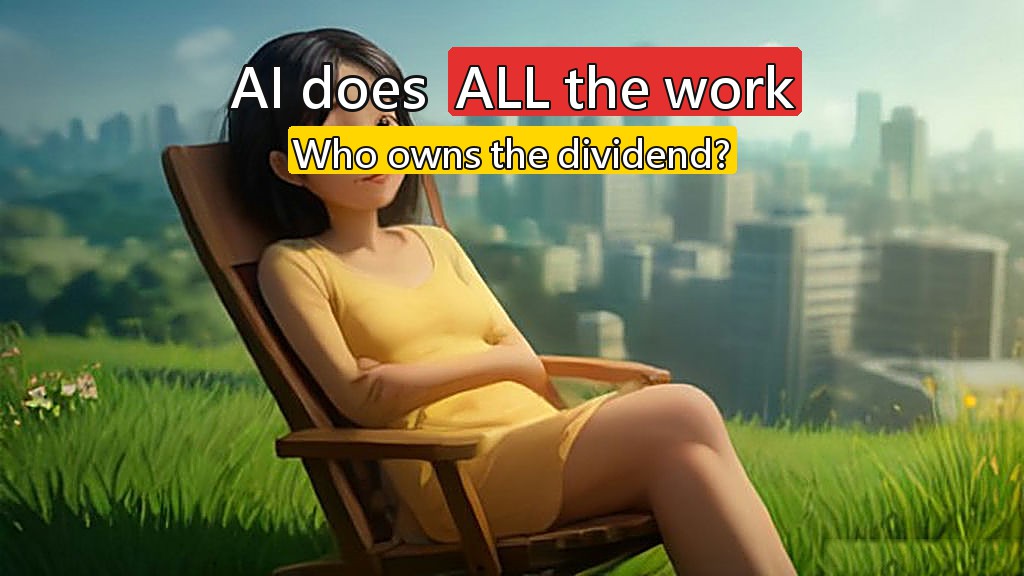
The engineer who builds the first dam at the river mouth deserves a handsome, honest return. What no individual and no oligarch may do is plant the turbines and then declare the entire river private property, collecting rent from the thirsty downstream forever. Once that window-paper is pierced, the property relations underneath are plain: every living person — coder or not, shareholder or not — holds original shares in human civilization, simply by using and carrying forward a human language and inheriting the order our ancestors built. When general AI matures from lab product into infrastructure as destiny-binding as water, electricity, and roads, its long-run dividends must flow back to the whole society that built its foundation — not become a rent-extraction machine pointed at humanity by a few. AI is not a god, and the companies and engineers who build it are not priests. AI is a public good by construction, and a meaningful share of everything it produces is common wealth.
AI dividend, not alms: a new humanism for the post-AI era
Lately I keep meeting brilliant people who genuinely love their craft, watch the newest model finish weeks of their work in minutes, and feel not relief but vertigo — the existential crisis of "am I already useless?" The pain has a precise source: two hundred years of industrialization drilled a reflex into all of us — measure a person's worth by their production-side market price. Ranked by exam scores at school; by salary, title, and headcount after. Security and dignity welded to indispensability on the production chain. To be fair, paying by contribution was a giant historical step forward from ranking people by bloodline and birth. But that entire rule rested on a silent premise: production needs humans, human contributions can be priced, and the market returns roughly fair payment. If AI replaces most labor, that premise dies — so how do we distribute?
Here is the fairest floor I can construct: carve a public dividend out of the surplus that AI creates in place of human labor, and distribute it equally, per person. Explicitly not a return to the egalitarian rice bowl: the frontier that humans still explore keeps rewarding the brave with steep, unequal prizes; the abundance that AI takes over gets shared unconditionally and identically. And under the dividend sits the liberating premise: once AI flattens production-side differences between people, society must stop measuring worth by production. People are not the input of production; people are its purpose. Every person is equally noble — equally, innately, absolutely — with no exam score, job title, or KPI report required as proof.
"Isn't that just the universal basic income tech executives keep promoting?" The definitions look similar; the philosophy underneath is opposite. In the standard cyberpunk picture — and in the dark-enlightenment salons recently fashionable in Silicon Valley — models and compute are the private estates of a few tech lords. The transfers to the displaced are alms: dog-biscuits tossed to preserve samples and buy quiet, ideally served with a soma so the caged stop minding the cage. The recipient has no bargaining power and, soon enough, no rights either; the giver writes the rules, and you check the donor's face before lifting the bowl. A dividend is the opposite instrument. Because every person holds civilization's original shares, the monthly credit in your account is not mercy — it is the shareholder payout on a five-thousand-year common inheritance. It is owed: no means test, no behavioral conditions, no gratitude required.
Once both scarcity of subsistence and scarcity of brains retire, the old iron laws deserve to be re-interrogated, one by one. Why exam drudgery that burns out teenagers before their lives begin? Why patent walls that lock knowledge and medicine behind fees? Why survival anxiety that trades half a lifetime of work-hours for groceries? Why meritocratic humiliation that seats people by score and net worth? Why winner-take-all gaps that lock shut across generations? "Without the whip of survival, won't humans degenerate into pets?" — honestly, the worry carries a black humor. Most people today are already sprinting through layoff rumors, mortgage statements, and exam gates, unable to afford the loafing they are being warned about. And a step further: on the day production genuinely no longer needs us, what each shareholder does with the dividend — build a spaceship, write a novel, assault a hard theorem, or sunbathe, game, walk the family, and master a beautiful unprofitable craft, happily "useless" by the old scoreboard — is entirely that person's call. No meritocratic ruler gets to grade it. As the old pamphlet put it: the free development of each is the condition for the free development of all. Post-AI freedom means both halves — freedom from toiling a lifetime for meals, and freedom from ever having to prove you are "useful."
A quick reality check
Three caveats keep this honest. The Riemann and P-vs-NP items were unconfirmed circulating rumors when written — thrilling, not verified results. The GTA6 figure follows the publisher's launch announcement. And the i-shaped endgame is a warning, not a prophecy: nothing above is destiny, the ending is still unwritten — which is exactly why the argument matters now.
The takeaway
For investors, the actionable reading is where durable scarcity migrates next: away from human labor toward compute, distribution, attention, and trust — watch who owns the toll booths. For everyone else, the deeper point stands on its own: your market price is not your worth, and the future of work is a design problem we still get to influence — by the jobs we build, the rules we demand, and the ownership we insist on. The discussion question for this community: does quantitative trading sit on capital's side of the divide or labor's — and what skill are you building that does not live on a screen? Comments open — rational, evidence-based discussion welcome.
Related reading: a 19-year-old building a $100K/month agency in the AI era and a zero-code AI playbook for solo builders.